
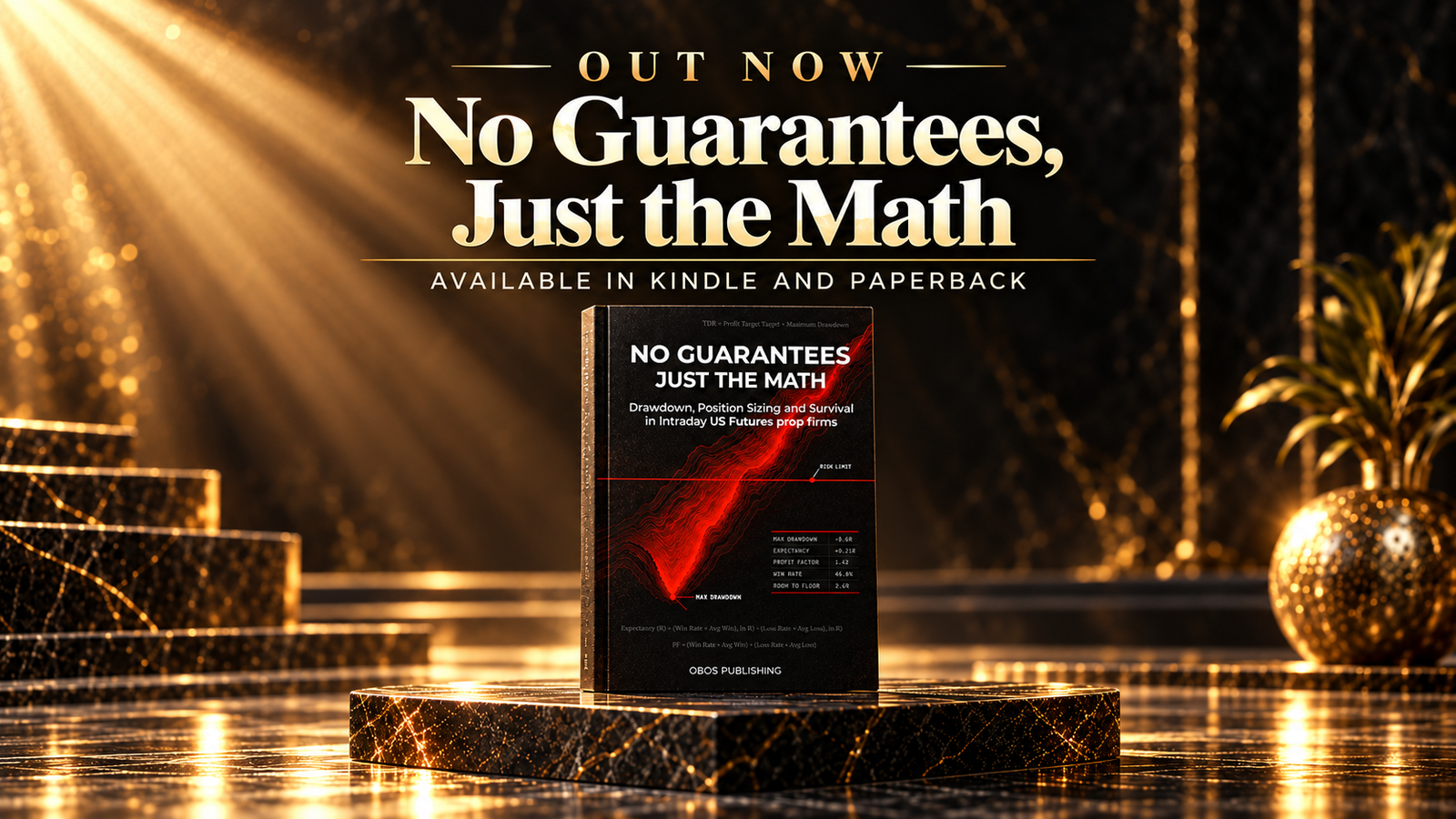
Our first book is out. It explains how funded-account evaluations really work and does the arithmetic the adverts leave out.
Why we wrote it
You can buy an evaluation in about ninety seconds. Understanding what you’ve bought takes considerably longer. Prop-firm adverts lead with the account size and the payout split. The figures that decide whether an account is hard to pass, and what passing is actually worth, sit further down the terms page, if you read that far.
The odds are not in the buyer’s favour. Industry data from FPFX Tech, reported by Finance Magnates in September 2024, found that only around 7% of challenge buyers ever received a payout. We wrote this book so that readers can see why before they pay a fee, not after.
What’s inside
The book is in four parts:
- How evaluations work: profit targets, the three drawdown types, daily loss limits, consistency rules, activity requirements, scaling plans and payout splits.
- The maths of futures trading: contract maths across products, position sizing against the drawdown room you have left, expectancy, risk of ruin, sample size and Monte Carlo simulation.
- Applying it across markets: three strategies tested against the evaluation rules from Part One.
- Building and protecting a trading plan: a plan the account can survive, the common mistakes, manufactured track records, copy trading across accounts, and what a payout really costs to reach.
Before any of that, a short opening chapter, Before You Buy: The Ten-Minute Check, gives you the five questions to answer from a firm’s terms page before you pay anything.
What it won’t do
It’s in the title. The book doesn’t promise that you’ll pass an evaluation or make money, and it doesn’t sell a strategy. It gives you the arithmetic to judge whether an account is compatible with the way you actually trade, and it labels every figure so you know whether you’re looking at a model, an example, or something to verify with your own firm.
Where to get it
No Guarantees, Just the Math is available on Amazon today.
Trading involves substantial risk of loss. This book is educational and is not financial advice. See our Risk Disclaimer.