

An evaluation can be bought in about ninety seconds. The opening chapter of No Guarantees, Just the Math exists for the time in between: the minimum you need to know before paying, so you don’t buy an account blind.
Account size is the wrong comparison
The number in the advert tells you very little. What separates one account from another is the profit target divided by the maximum drawdown: how much you must earn, relative to how much you’re allowed to lose.
A $50,000 account with a $3,000 target and a $2,000 drawdown has a ratio of 1.5. A $25,000 account with a $1,500 target and a $1,000 drawdown has the same ratio and is exactly as hard, at half the headline size.
$50,000 isn’t $50,000 to trade with
On that first account, you have $2,000 of room before it closes. That’s 4% of the advertised figure. At $200 of risk per trade, it’s ten losing trades. For a strategy that wins about half the time, a run of ten losses somewhere in its first few hundred trades is ordinary variance, not bad luck.
It isn’t really a $50,000 account with rules attached. It’s a $2,000 risk budget with a $50,000 label.
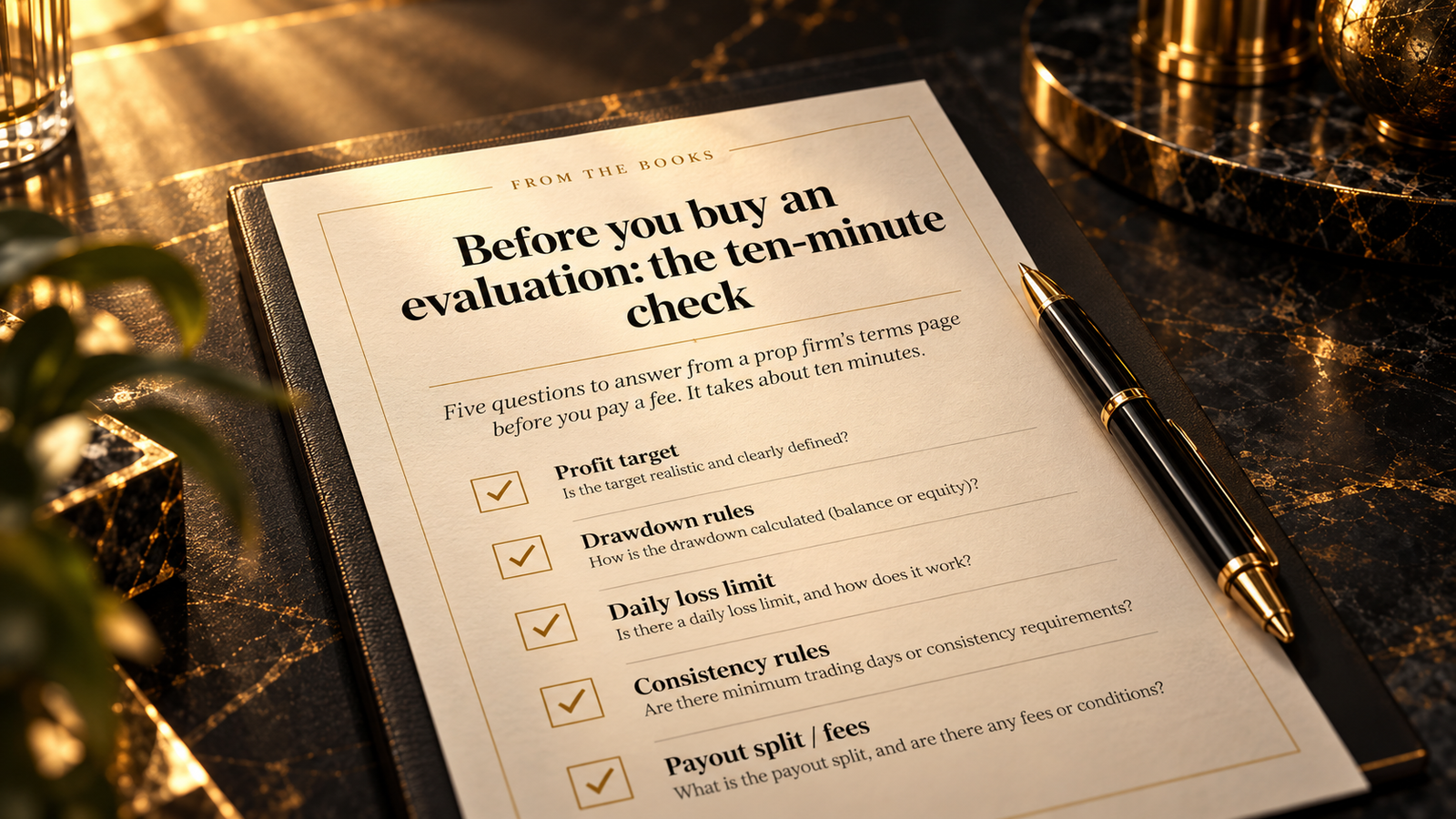
The five questions
You can answer all five from the terms page. If you can’t answer all five, you haven’t finished reading the terms.
- What is the target-to-drawdown ratio, and how does it compare with the other accounts you’re considering?
- Which type of drawdown applies, and does it lock at a set balance?
- What is the daily loss limit, and at what balance does it stop protecting the account?
- Is there a consistency rule, and does it apply at the evaluation stage, the funded stage, or both?
- What must happen before you can actually withdraw money, and what happens to your profit if you breach a rule?
What ten minutes can’t tell you?
None of this says whether an evaluation is worth buying. That depends on your strategy’s expectancy, its costs, and how it behaves against that specific account’s rules. What the check does is change the question from “is this a good account?”, which has no general answer, to “is this account compatible with the way I trade?”, which does.
The rest of the book answers that second question.
Figures in this post are illustrative. Account terms vary between firms: always check the current terms of any account before buying.