

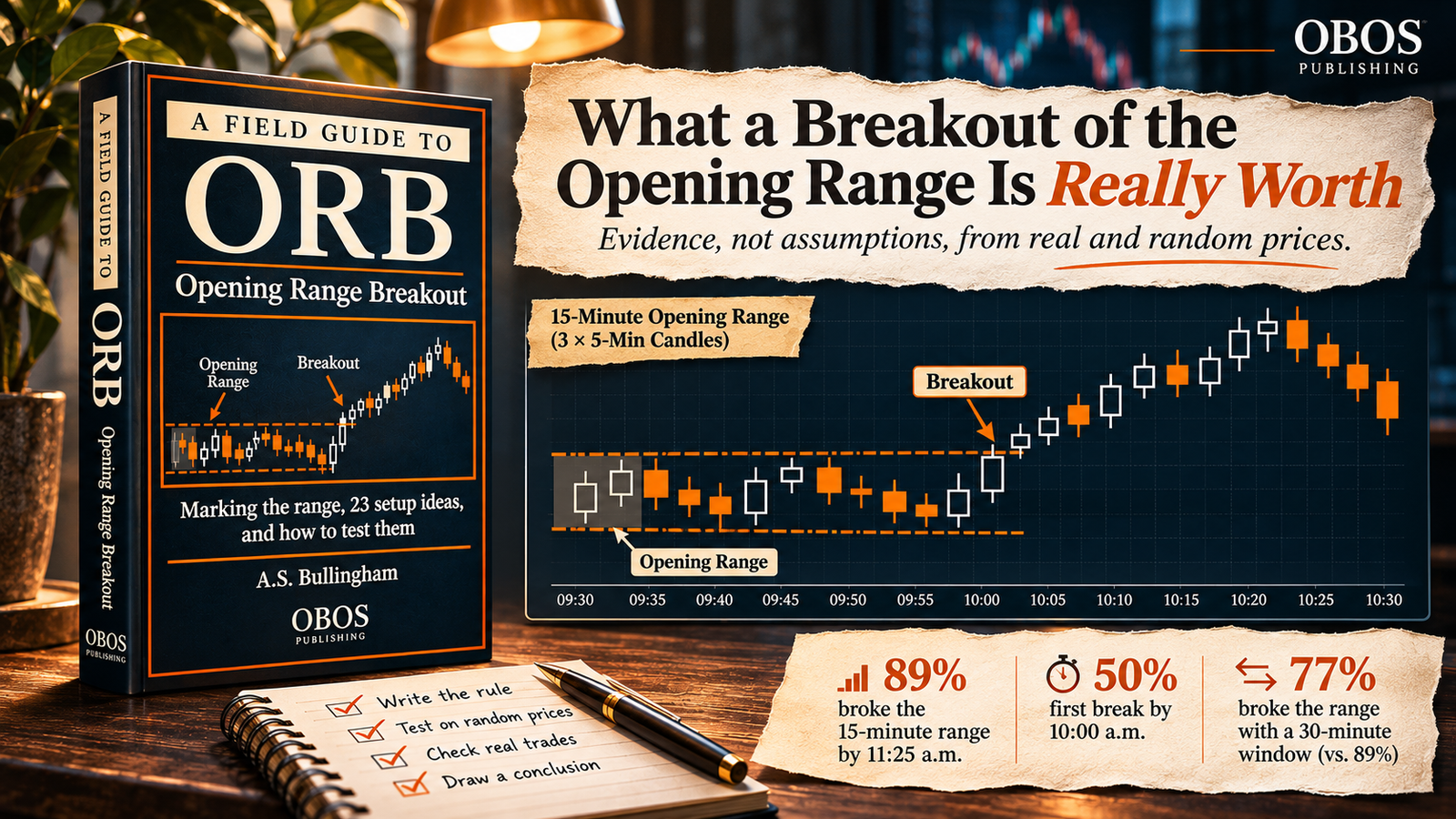
Every trader can mark the opening range. Few know what a break of it is really worth.
The opening range breakout is one of the oldest ideas in day trading. Mark the high and low of the first few minutes of the session, then trade in the direction of whichever side breaks. It’s simple, it’s easy to see on a chart, and it feels like a signal: the market has picked a direction, so you go with it.
I wrote A Field Guide to ORB because that feeling is worth checking before you trust it. Before asking what a breakout can make, I wanted to know how often one turns up when there’s nothing behind it.
What Random Prices Show About the Opening Range Breakout
On random prices, the opening range breaks almost every day, and it breaks early. In the book, I ran the same rules on tens of thousands of random sessions: prices built so that no pattern can predict the next move. Here’s what the 15-minute range did on them.
- It nearly always breaks. By the 11:25 a.m. candle, 89% of random sessions had closed beyond the range, and 36% had closed beyond both sides.
- It breaks fast. The first close beyond the range came on the 9:45 a.m. candle, the first one after the range, on 27% of sessions. By 10:00 a.m. it had happened on 50%, and by 10:30 a.m. on 74%. The median first breakout closed 15 minutes after the range was complete.
- A longer range doesn’t change the picture much. Doubling the window to 30 minutes cut the share of sessions with a close beyond the range from 89% to 77%, and the share that closed beyond both sides from 36% to 28%.
- A quiet start isn’t a signal on its own. Narrow ranges were broken more often, sooner, and by more widths than wide ones. Yet the trades from the book’s running example averaged close to zero whatever the range’s width.
None of this says breakouts never work. It says an opening range breakout, by itself, is the ordinary case: the high and low of the first 15 minutes sit close to where the price already is, so the price wanders past them early.
What That Means for a Trader
If the range breaks on most days whether or not there’s anything to find, then “the range broke” can’t be the whole reason for an opening range breakout trade. An early breakout is what prices do anyway. A trader who reads urgency into it is reading the calendar of a random walk.
That’s why the book treats every opening range breakout setup the same way:
- Write the rule down. Which range, which candle confirms the break, where the entry goes, where the stop goes, and where the target is. If you can’t write it down, you can’t follow it.
- See what it does on prices with nothing in them. If a setup fires just as often on random sessions, the signal alone isn’t telling you much.
- Look at real trades, both kinds. A rule that never loses on paper hasn’t been looked at closely enough.
- Test it before you trust it. On your own market, your own timeframe, and enough sessions to mean something.
This isn’t a prediction. It’s a probability, and it’s worth knowing before the open, not after it.
What’s in the Book
A Field Guide to ORB turns the opening range breakout into exact rules, with the evidence beside each one. The examples come from US stocks, a semiconductor fund, and stock-index and crude oil futures.
- Ranges and levels, marked step by step. The first candle, the 15- and 30-minute ranges, the first hour, the premarket and overnight highs and lows, and the levels set from the open.
- 23 opening range breakout setup ideas with exact rules. First breakouts, retests, failed breakouts, gaps, and distance setups, each with its timeframe, what to measure first, and its entry, stop, and target.
- Real trades that worked, and real trades that failed. Every setup has one real trade that reached its target and one that reached its stop, drawn by lot rather than picked by eye, plus five real trading days walked through from the open.
- What chance alone does at the open. Every setup runs on tens of thousands of random sessions, so you can see how often a “signal” appears when there’s nothing to find.
- A plan for the open, and a way to test it. Orders, trading halts, stops, targets, and filters, then how to write your own rule and test it without fooling yourself.
- 81 charts, with notes on how the open works in London, continental Europe, and Asia.
Who It’s For
The book is for beginners and early-intermediate traders in stocks and futures who want to trade the opening range breakout by written rules. No coding is needed, and Parts 1 to 4 need only simple arithmetic. It isn’t for anyone who wants a ready-made trading system. No hype, no guarantees: just the rules, the evidence, and where each one fails.
A Field Guide to ORB: Opening Range Breakout – Marking the range, 23 setup ideas, and how to test them is available in paperback and ebook at obos.store, and on Amazon, Apple Books, and Google Play.
Trading involves substantial risk of loss. This article and the book are for education only and are not financial advice.